25 years strengthening Australia’s plant biosecurity

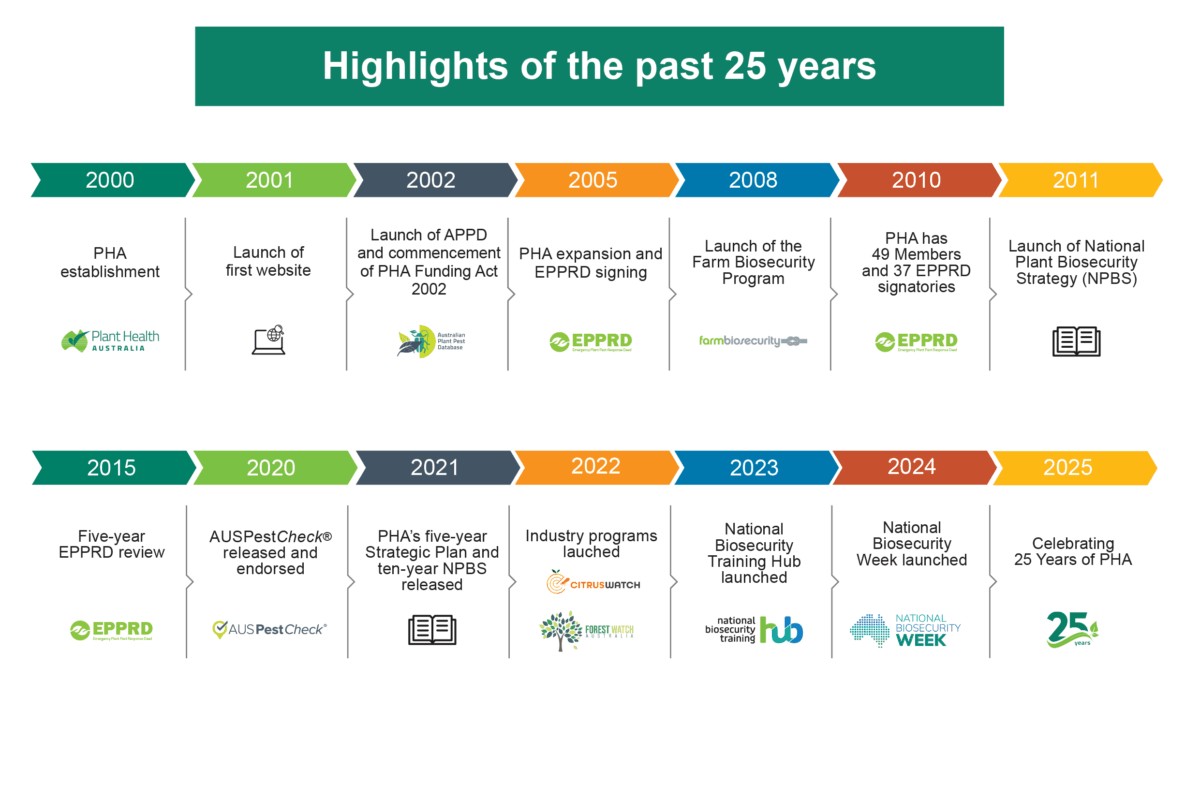
For 25 years, Plant Health Australia (PHA) has played a central role in safeguarding Australia’s plant industries, food security, environment and way of life. Established in 2000 as a not‑for‑profit partnership between government and industry, PHA was created in response to the need for a nationally coordinated approach to plant biosecurity built on the power of shared responsibility and collective effort.
Marking the end of its 25th year, PHA looks back on a quarter century as the national coordinator of plant biosecurity in Australia and reflects on the impact of partnerships and collaboration in managing increasingly complex biosecurity risks.
Building a national partnership for biosecurity
From its inception, PHA was designed as a partnership between plant industries and governments bringing together the Australian Government, all state and territory governments, and peak plant industry bodies enabling shared decision‑making and collective investment in biosecurity outcomes.
Over time, this partnership has expanded beyond traditional stakeholders. PHA now works closely with a range of stakeholders across the supply chain, strengthening national and global connections to address emerging threats. Through this collaborative approach, PHA has helped embed a culture of shared responsibility across the supply chain.
Transforming emergency response capability
One of PHA’s most significant and enduring achievements has been the establishment and custodianship of the Emergency Plant Pest Response Deed (EPPRD).
Ratified in 2005, the EPPRD is a world‑leading agreement that sets out how governments and plant industries work together to respond to exotic plant pest incursions. Prior to the EPPRD, response arrangements were ad hoc, uncertain and financially unsustainable. The EPPRD introduced a transparent, equitable framework for shared decision‑making, cost‑sharing and owner reimbursement costs, dramatically strengthening Australia’s ability to respond to emergencies.
Over the past 20 years, the EPPRD has underpinned numerous nationally coordinated responses, including response programs for high‑risk pests such as citrus canker, khapra beetle, banana freckle, brown marmorated stink bug and seasonal exotic fruit flies. Where eradication has not been feasible, the EPPRD has enabled agreed transitions to long‑term management, ensuring clarity, fairness and continuity.
Complementing the EPPRD, PHA also developed PLANTPLAN, Australia’s nationally consistent emergency plant pest response plan. PLANTPLAN provides practical guidance from governance arrangements to operational procedures, to support preparedness and response at national, state and local levels. Together, the EPPRD and PLANTPLAN form the backbone of Australia’s emergency plant pest response arrangements.
Strengthening preparedness, surveillance and diagnostics
Beyond emergency response, PHA has invested heavily in strengthening Australia’s biosecurity preparedness and early warning capability.
PHA has led and supported national coordination in surveillance, diagnostics and risk mitigation, recognising that early detection is the most effective defence against plant pest incursions. Through initiatives such as the National Plant Biosecurity Diagnostic Network and the Plant Surveillance Network Australasia Pacific, PHA has helped build professional capability, improved national protocols and consistency, and fostered collaboration among specialists both nationally and internationally.
Industry specific biosecurity programs spanning grains, horticulture, forestry, citrus, bees and more, have further tailored preparedness to sector specific risks, translating national strategies into practical, on farm action.
Leveraging Digital Systems and data
As biosecurity challenges have grown more complex, PHA has increasingly harnessed technology to support decision making.
PHA administers and supports several nationally significant digital platforms, including AUSPestCheck®, the Australian Plant Pest Database, and the Pest and Disease Image Library. These systems bring together surveillance, diagnostic and reference collection data from across Australia, transforming information into intelligence that supports market access, policy decisions, emergency responses and research on established taxa.
Through these digital systems, PHA has enhanced national identification and detection capability across Australia that reflects biosecurity risk profiles and increased awareness of the use of innovative technologies and approaches in plant biosecurity.
Building capability through training
A well prepared biosecurity system relies on people as much as plans and technology. Over 25 years, PHA has built cohesive networks of informed and capable industry, government, and community stakeholders ready to respond to biosecurity threats.
Through the Biosecurity Online Training (BOLT) platform, tailored industry training, simulations and the National Biosecurity Training Hub, PHA has built biosecurity response capability to prevent, detect and respond to biosecurity threats.
Simulation exercises have tested and strengthened Australia’s readiness and best-practices, supporting continual and shared learning.
Raising awareness of biosecurity and engaging the community
Effective biosecurity depends on informed and engaged people. PHA has played a leading role in elevating biosecurity awareness through strategic communications, national campaigns and stakeholder engagement.
In 2024, PHA launched the inaugural National Biosecurity Week, establishing an annual event that highlights the collective efforts of government, industry, peak bodies and the community in protecting the Australian way of life. The long-running Spotted Anything Unusual campaign, tailored with industry-specific messaging raises awareness of biosecurity and reporting mechanisms with growers and regional communities. These initiatives reflect PHA’s growing emphasis on community engagement and participation in biosecurity.
PHA has also been recognised nationally for excellence in biosecurity communication for the National Biosecurity Training Hub launch campaign, reinforcing the importance of clear, timely and trusted information, particularly during emergencies.
Looking ahead: A strong foundation for the future
As PHA reflects on 25 years of strengthening Australia’s plant biosecurity system, it does so against a backdrop of a rapidly evolving risk landscape. Climate change, global trade, urbanisation and emerging pests continue to increase the complexity and scale of biosecurity challenges.
Guided by its Strategic Plan 2022–2027, PHA is building on its strong foundation strengthening national response arrangements, deepening partnerships, enhancing data integration and continuing to act as a trusted knowledge broker for plant biosecurity.
PHA continues to be the trusted mainstay of Australia’s plant biosecurity system, providing a national repository of plant biosecurity knowledge. In a federated system characterised by changing personnel, evolving policy settings and increasingly complex biosecurity risks, PHA provides critical continuity, institutional memory and national perspective. PHA brings unparalleled longitudinal insight to plant biosecurity, underpinning the development of interconnected information systems, facilitating alignment of agricultural and food strategies to support long term agricultural growth, and working collaboratively to reduce duplication and fragmentation across research and development programs. Through this leadership, PHA consistently highlights and strengthens the value of Australia’s national plant biosecurity system as a source of resilience, confidence and market advantage.
The past 25 years demonstrates that collaboration works. Through shared responsibility, sound governance and sustained investment, PHA has helped protect Australia’s environment, agricultural industries and way of life and is well placed to continue doing so for decades to come.